
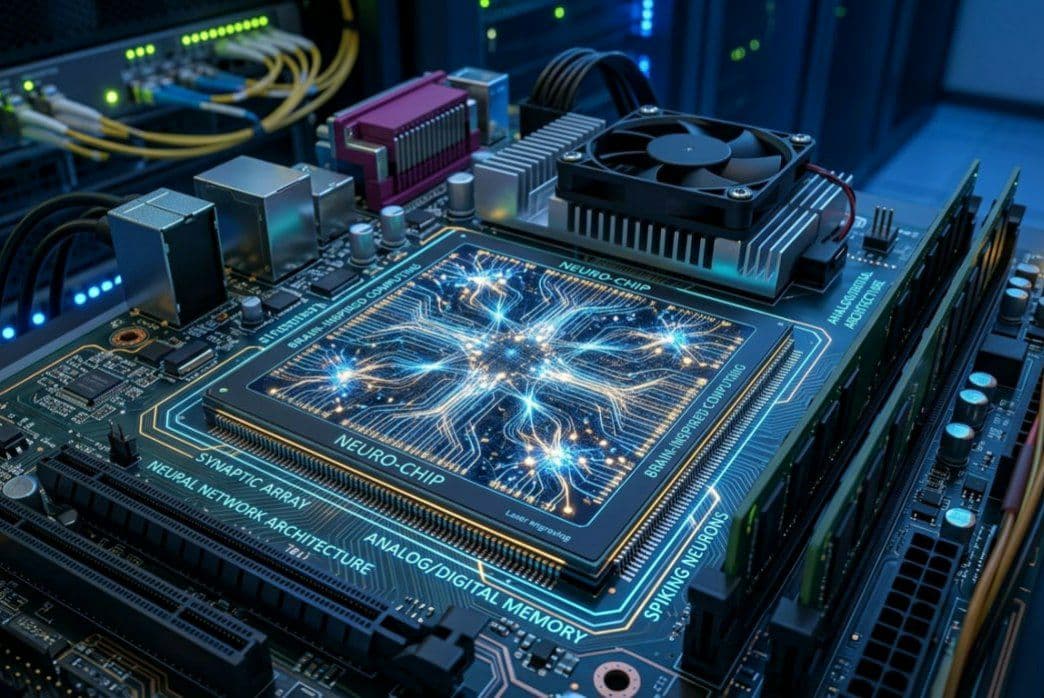
Neuromorphic Computing: AI That Thinks Like a Brain
By Yididya Solomon
“ Total annual U.S. electricity consumption hit a record high in 2024. U.S. data centers consumed 183 terawatt-hours (TWh) of electricity in 2024, according to IEA estimates. That works out to more than 4% of the country’s total electricity consumption last year – and is roughly equivalent to the annual electricity demand of the entire nation of Pakistan…” [1]. Data centers, which form the backbone of modern artificial intelligence systems, are notorious energy consumers. As AI models grow larger and more complex, their power demands continue to rise. This raises a critical question: is there any alternative to building AIs that aren’t power-intensive while at the same time delivering the very efficient computations? One promising answer to this challenge is neuromorphic computing.
Neuromorphic computing is an emerging field that involves designing hardware and software to emulate the neural and synaptic structure and operation of the human brain. These systems use energy-efficient electrical networks modeled after biological neural circuits to process information more efficiently. In the nervous system, neurons serve as the fundamental unit of information transmission, while the tiny gaps between them are known as synapses. Therefore, when a neuron becomes active, it sends an electrical signal, or spike, that travels via the synapses to other neuron enabling efficient communication of information in the brain. Neuromorphic computing adopts an equivalent artificial model called Spiking Neural Networks (SNNs).
Each neuron in the SNN sends signal pulses encoded with information to other neurons, which constantly results in a variation of electrical states. In neuromorphic hardware, synapses are typically implemented using transistor-based synaptic devices, which regulate how electrical signals are transmitted between neurons. SNNs factor timing into their operation. A neuron’s charge value accumulates over time, and when that charge reaches the neuron’s associated threshold value, it spikes, propagating information along its synaptic web. But if the charge value doesn’t go over the threshold, it dissipates and eventually “leaks,” preventing unnecessary activity and reducing energy consumption.
Traditional digital computers used in everyday devices such as smartphones and laptops are governed by the principle of von Neumann architecture, where the processor (CPU) and memory are physically separated; the CPU performs computations, while data and instructions are fetched from memory through a shared communication bus. However, this separation introduces a fundamental limitation known as the von Neumann bottleneck.
“ The farther away the memory is from the processor, the more energy it costs to move it. On a basic physical level, an electrical copper wire is charged to propagate a 1, and it’s discharged to propagate a 0. The energy spent charging and discharging the wires is proportional to their length, so the longer the wire is, the more energy you spend. This also means greater latency, as it takes more time for the charge to dissipate or propagate the longer the wire is.” [2]
As AI demands massive data movement, this architectural inefficiency becomes a major contributor to power consumption. That’s when neuromorphic computing comes to solve this problem, since the hardware architecture is designed in a way that resembles the human brain, memory and computation are tightly co-located rather than physically separated. Instead of relying on a centralized CPU, neuromorphic systems are built from many small processing units that combine computation and memory at the same location, much like neurons and synapses in the brain. When these tiny units are interconnected, they form a large, highly parallel network capable of processing information efficiently.
Garrett Kenyon[3] points out the limitation of today's AI through an illustrative example involving self-driving cars. “A group of technological pranksters flashed the cars with t-shirts emblazoned with STOP signs. The cars, unable to discern context, responded by stopping, demonstrating the deterministic nature of current AI algorithms. The car’s behavior is a product of feedforward processing. “I see a STOP sign; therefore, I stop.” Neuromorphic computers, like biological networks, are designed to process information through feedback loops and context-driven checks. “I see a STOP sign. But that STOP sign is on a t-shirt. I drive on—cheeky kid.” [4]
As today’s AI models are largely based on conventional neural network training and inference, they struggle with contextual understanding and common sense. Neuromorphic computing, by aligning computation more closely with human cognition, aims to enable interpretation, adaptability, and learning at dramatically lower power levels, resulting in AI models that operate with significantly lower power consumption, typically similar to the brain, which uses 20 watts, reducing the environmental risks associated with large data center facilities. “The scientists’ near-term goal is to build out a design for a neuromorphic computer that sits within a two-square-meter box and houses as many neurons as the human cerebral cortex. Calculations suggest this computer could operate between 250,000 up to 1,000,000 times faster than a biological brain and uses just 10 kilowatts of power, a bit more than a home air conditioning unit.” [5]
References
[1]Beshay. (2025, October 24). What we know about energy use at U.S. data centers amid the AI boom. Pew Research Center. Retrieved from https://www.pewresearch.org
[2] Hess, P. (2025, February 14). Why a decades old architecture decision is impeding the power of AI computing. Retrieved from https://research.ibm.com/blog/why-von-neumann-architecture-is-impeding-the-power-of-ai-computing
[3] A computational neurologist at Los Alamos National Laboratory
[4] Dickman, K. (2025, July 1). Neuromorphic computing: the future of AI. Retrieved from https://www.lanl.gov/media/publications/1663/1269-neuromorphic-computing
[5] Dickman, K. (2025, July 1). Neuromorphic computing: the future of AI. Retrieved from https://www.lanl.gov/media/publications/1663/1269-neuromorphic-computing
● Caballar, R. D., & Stryker, C. (2025, November 17). Neuromorphic computing. Ibm. https://www.ibm.com/think/topics/neuromorphic-computing ● Dickman, K. (2025, July 1). Neuromorphic computing: the future of AI. Retrieved from https://www.lanl.gov/media/publications/1663/1269-neuromorphic-computing ● Neuromorphic computing—the next generation of AI. (n.d.). Retrieved from https://www.intel.la/content/www/xl/es/research/neuromorphic-computing.html ● Hess, P. (2025, February 14). Why a decades old architecture decision is impeding the power of AI computing. Retrieved from https://research.ibm.com/blog/why-von-neumann-architecture-is-impeding-the-power-of-ai-computing ● GeeksforGeeks. (2024, June 2). Neuromorphic computing. Retrieved from https://www.geeksforgeeks.org/computer-networks/neuromorphic-computing/